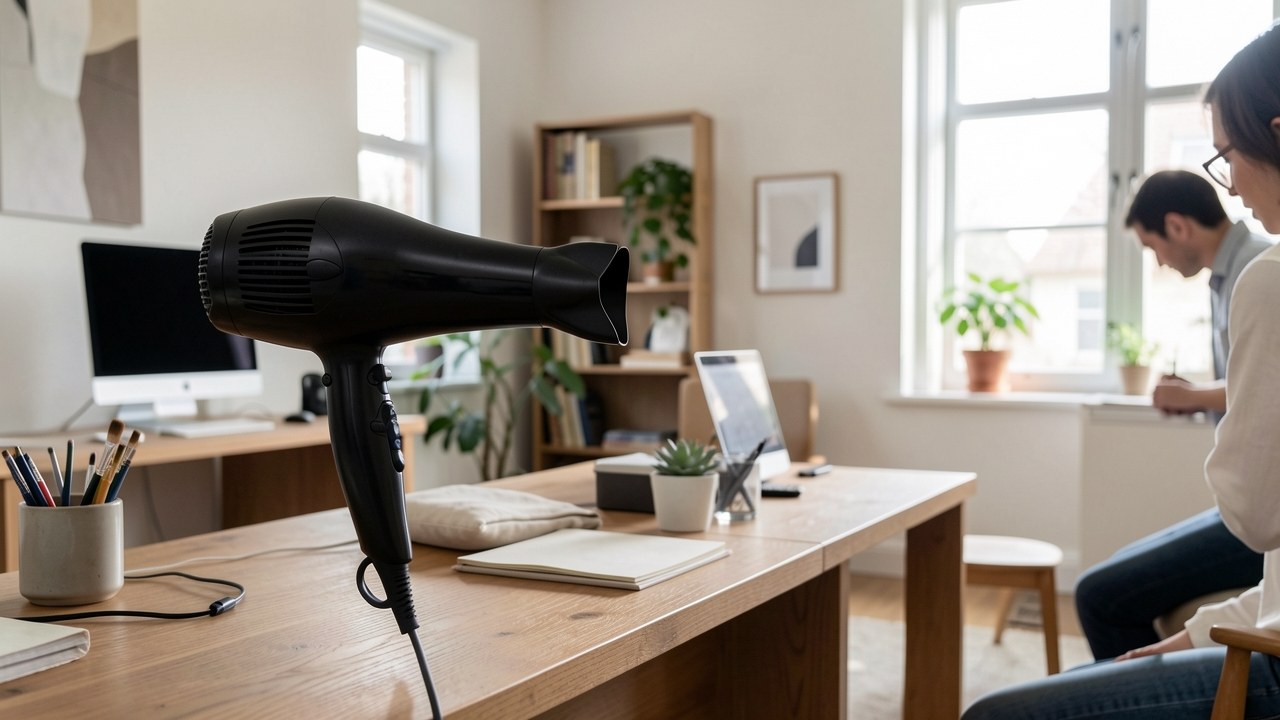
What a hair dryer actually does to hair
A hair dryer blows ambient air and, at hot or warm settings, speeds up drying while shaping hair as it dries. The setting effect works through temporary hydrogen bonds inside each strand: blow drying helps arrange them while the hair is still damp, and a single wash undoes them again.
The bigger practical question is surface damage. A peer-reviewed in vitro study shampooed and dried hair tresses 30 times over 30 days and compared no treatment, natural air drying at room temperature, and hair dryer drying for 60 seconds at 15 cm (47 C), 30 seconds at 10 cm (61 C), and 15 seconds at 5 cm (95 C). Hair surfaces tended to become more damaged as the temperature rose.
The same study found no cortex damage in any group, which the authors suggest means the hair surface may act as a barrier protecting the cortex. It also found the cell membrane complex damaged only in the naturally dried group that did not use a hair dryer. The study concluded that although a hair dryer causes more surface damage than natural drying, using it at 15 cm with continuous motion causes less damage than drying hair naturally.
Two limits matter for reading that study honestly. It tested chemically untreated hair tresses in a laboratory, not people or scalps, and it dates from 2011. Its distances and temperatures are study conditions, not a household protocol.
A separate finding on moisture deserves care: moisture content fell in all treated groups compared with the untreated control, but the differences between groups were not statistically significant. One finding did show up early: drying at ambient and 95 C conditions appeared to change hair color toward lightness after only 10 treatments in that protocol.
- Hydrogen bonds explain temporary shape, not permanent change: washing resets them.
- Heat and airflow are the two mechanisms that dry hair.
- Note the counterintuitive result: the cell membrane complex was damaged only in the naturally dried group.
- The study is in vitro and from 2011; treat its numbers as findings, not as a safety standard.
Sources: Annals of Dermatology (PMC), PubMed (U.S. National Library of Medicine), Wikipedia
Key features explained: heat, airflow, wattage, ionic and ceramic
Heat and speed settings are what you actually live with day to day. Consumer Reports frames it plainly: heat and airflow speed are the main mechanisms by which a blow dryer dries hair, so a lower heat setting takes longer than a higher one, and the same holds for speed. That means the numbers that matter most for routine use are the ones on the temperature and speed controls, not the headline on the box.
Wattage is a rough proxy, not a guarantee. Consumer Reports quotes a hair restoration surgeon saying about 1,800 W is good for home use, that a lower wattage such as 1,200 W may mean drying hair longer because the dryer cannot reach higher temperatures, and that lower wattage tends to mean a smaller, lighter motor and a more compact device. Manufacturer sources quote different ranges, so no single wattage figure is a standard.
A cool shot button turns off the heater and blows room-temperature air while pressed. Sources describe it as helping to set a hairstyle, reduce frizz and promote shine. Consumer Reports attributes the styling-set explanation to hair restoration surgeon Nilofer Farjo.
Ionic operation is intended to reduce static electricity build-up, and manufacturers claim it makes hair smoother. Its efficacy is contested. Good Housekeeping states that its testing found advertised ceramic, tourmaline and far-infrared technologies not easily distinguishable and that little data exists on their specific benefits in hair dryer design. Ceramic heating elements are described as distributing heat evenly, and a 2007 survey of stores found most hair dryers used ceramic elements because of their instant-heat capability.
Motor construction quietly affects how long a dryer lasts. In a brushless motor, permanent magnets conduct the current that spins the motor instead of metal brushes, which reduces friction, so a brushless motor tends to last longer. Consumer Reports attributes that explanation to Sam Burrowes, lead design engineer at Dyson.
A note on advertised temperatures: the IEC 61855 measurement standard specifies thermocouple-grid test distances such as 25 mm and 100 mm for outlet air temperature and requires ambient-temperature compensation. That is why outlet-temperature numbers from different brands are not directly comparable, and why a figure like 120 C in trade literature is a comparison reference rather than a daily-use recommendation.
- Heat and speed settings do more to change your routine than any single advertised technology.
- Wattage is a ballpark for home use, not a standard.
- Cool shot is the one feature consistently described as helping set a style and reduce frizz.
- Ionic, ceramic and tourmaline claims sit in disputed territory: brand sources assert benefits, independent lab testing finds them hard to distinguish.
- A brushless motor is the mechanism most clearly linked to durability.
- Outlet-temperature figures are measured under different distances and ambient compensation, so they are not directly comparable across brands.
Sources: Wikipedia, Consumer Reports, Good Housekeeping (Good Housekeeping Institute Beauty Lab), Sam Villa, AENO, BOMA
Matching features to hair type
Consumer Reports attributes to a hair restoration surgeon a practical pairing: straight, short or medium-length lightweight hair takes less time to dry and suits high speed with cooler settings, while thick, wavy or curly hair takes longer and suits low speed with a high heat setting. The same source notes other factors such as a humid room also matter. That is guidance from a named clinician, not a settled quantitative rule, but it gives you a starting point.
Stylist guidance reported by Consumer Reports goes further on speed: a low speed gives more control and suits a supersmooth, frizz-free finish, while a high speed suits a quick rough dry. Professional education content describes settings in the same practical terms.
Good Housekeeping advises that the key to choosing a dryer for a hair type is finding one with customizable settings. For curly hair in the 3a to 4c range, it suggests an ionic dryer with attachments, treats a diffuser as essential, and recommends a narrow nozzle for smoothing. The 3a to 4c range is one widely used curl-typing convention, not a standardized clinical classification.
One dissenting view is worth knowing. Allure reports stylist guidance that for finer hair needing more volume, a traditional non-ionic blow dryer may be preferable to an ionic dryer. That runs against the general ionic recommendation and is recorded as attributed guidance rather than settled fact.
The honest summary is that no feature is universally best. Adjustable heat and speed, an attachment or two that fits how you actually wear your hair, and a weight and cord length you can live with tend to matter more than any single technology label.
Here is how the main categories line up against the decisions you make at the shelf or in your cart:
- Fine, straight or lightweight hair: less drying time, cooler settings, higher speed for rough drying.
- Thick, wavy or curly hair: longer drying time, low speed and higher heat for a rough dry.
- Coily hair in the 3a to 4c range: customizable settings, an ionic option, a diffuser as essential and a narrow nozzle for smoothing.
- Fine hair needing volume: some stylists prefer a non-ionic dryer; treat this as one opinion, not a rule.
| Hair situation | Heat setting starting point | Speed setting starting point | Attachment that fits | What to look for when buying |
|---|---|---|---|---|
| Straight, short or medium-length, lightweight | Cooler settings | High speed | Concentrator nozzle for smoothness | Adjustable heat and speed, comfortable weight |
| Thick, wavy or curly | High heat for a rough dry | Low speed | Diffuser for curl definition | Customizable settings, ionic option, diffuser included or available |
| Coily hair in the 3a to 4c range | Customizable settings you can step down | Low speed | Diffuser as essential, narrow nozzle for smoothing | Adjustable heat and speed, an ionic option, attachments included |
| Fine hair needing volume | Moderate heat | Medium to high speed | Concentrator for lift at the root | Some stylists suggest a non-ionic dryer here; treat as an option, not a rule |
Sources: Consumer Reports, Good Housekeeping (Good Housekeeping Institute Beauty Lab), Allure, Sam Villa
Safe drying basics: distance, angle, heat and time
Distance is the best-evidenced part of this page. The peer-reviewed study found that using a hair dryer at 15 cm with continuous motion causes less damage than drying hair naturally. A manufacturer source recommends keeping 15 to 20 cm of distance and keeping the dryer moving to avoid local overheating, and a second manufacturer source gives at least about 6 inches, which is roughly 15 cm. The 15 cm figure is the point where independent and manufacturer guidance agree.
Heat is a gradient, not a cliff. In the study, hair surfaces tended to become more damaged as temperature increased across the tested conditions of 47 C at 15 cm, 61 C at 10 cm and 95 C at 5 cm. There is no threshold below which the study found zero damage. That is why the study authors describe their conclusion in comparative terms rather than as a safe limit.
Time interacts with heat and distance. The study used standardized drying times of 60 seconds at 15 cm, 30 seconds at 10 cm and 15 seconds at 5 cm in its protocol. Those are study conditions, not a household routine. Manufacturer practice advice adds two time-related points: absorb excess water with a towel first to shorten heat exposure, and dry to about 70 to 80 percent before styling. The 70 to 80 percent target is not established by independent evidence, but towel-absorbing first is a low-cost step that fits what the study measured.
Angle is the weakest area of the evidence. The only basis for angle guidance is the study's continuous-motion condition and manufacturer instructions to keep the dryer moving. Treat continuous motion as the supported practice and skip claims about a particular degree setting.
- Keep the dryer at about 15 cm (roughly 6 inches) from the hair, and keep it moving. This is the one point where independent and manufacturer guidance agree.
- Stay on lower heat for regular drying; surface damage increased with temperature in the study's tested conditions.
- Towel-absorb excess water first to shorten the time heat is applied.
- Continuous motion is the supported practice. No specific angle is established by the available evidence.
- No safe maximum temperature, session length or weekly frequency is established by the evidence on this page.
Sources: Annals of Dermatology (PMC), PubMed (U.S. National Library of Medicine), BOMA, AENO
Attachment overview: diffuser, concentrator, comb, brush
Attachments change the shape of the airflow, and the way the market and practitioners describe them is fairly consistent across sources. A concentrator nozzle directs airflow for precision and is treated as the universal attachment, which is why it usually comes in the box. A diffuser is described as suited to curly and porous hair because it spreads the airflow instead of concentrating it.
For styling purposes, stylists report using a narrow nozzle to smooth the hair and a diffuser as essential for curly hair. Good Housekeeping describes a specific high-end dryer as coming with five magnetic attachments, and Allure reports the same model including five attachments, but those are product-level specifications rather than a claim that more attachments produce better results.
Comb and brush attachments sit in the same category: they combine airflow with mechanical tension or shaping.
- Concentrator: directs airflow for precision; universally compatible and usually included.
- Diffuser: spreads airflow, described as suited to curly and porous hair, and treated as essential for curly styling.
- Narrow nozzle: used to smooth the hair.
- Comb and brush attachments: combine airflow with shaping; no independent effectiveness claim is available.
How to use this guide
This page is the hub. The fastest route is to start from your hair type and texture, then move to the technique and attachment pages once you have settled on a category of dryer.
If you are still choosing a device, the fine hair page covers the settings and buying considerations that matter most when hair dries quickly. If you already own a dryer and want to use it better, the safe drying technique page expands on distance, motion and heat. The attachments page covers diffusers, concentrators and the rest in more detail. The hair type guides index collects the type-by-type material in one place.
Two pages explain how this site is put together. The about page describes who writes it, and the editorial policy page describes how sources are selected and how conflicts between sources are handled. Nothing on this site is a substitute for advice about a scalp or hair-loss condition from a qualified professional.
- Choosing a dryer: start with the hair type and texture material, then move to fine hair if that is your situation.
- Using a dryer you already own: go straight to safe drying technique.
- Attachments: read the attachment overview, then the dedicated attachments page.
- Site background: about and editorial policy.
Common mistakes at a glance
Most avoidable problems come from a handful of habits rather than from the dryer itself. None of the points below requires a specific product or a specific brand.
- Holding the dryer too close. Damage to the hair surface increased as temperature rose across the study's tested distances and temperatures.
- Holding it still. The study's less-damaging condition was 15 cm with continuous motion, and manufacturer guidance says the same.
- Treating advertised ionic, ceramic or tourmaline claims as measured benefits. Independent lab testing found these technologies not easily distinguishable, and little data exists on their specific benefits in hair dryer design.
- Assuming higher wattage always means faster drying. Wattage is a rough proxy; heat and airflow together determine drying, and a lower-wattage dryer may simply mean drying longer.
- Ignoring the filter. If your dryer has one, clear it periodically, because a blocked filter can cause the dryer to overheat. Your owner's manual is the place to check whether a filter exists and how often to clear it.
- Choosing a dryer with fixed settings and then trying to compensate with technique. Customizable settings are what let you match the dryer to your hair type.
- Expecting a heat protection product to substitute for good technique. Manufacturer sources describe these products as forming a protective layer between hair and heat, but no clinical or regulatory evidence on efficacy was available for this page.
Sources: Annals of Dermatology (PMC), Consumer Reports, Good Housekeeping (Good Housekeeping Institute Beauty Lab), Sam Villa, AENO
Frequently asked questions
Does a higher wattage hair dryer dry hair faster?
Not by itself. Consumer Reports frames the drying mechanism as heat and airflow speed together, so a higher-wattage dryer can reach higher temperatures and move more air, but the settings you choose still determine how fast your hair actually dries. The same source notes that a lower wattage such as 1,200 W may mean drying hair longer because the dryer cannot reach higher temperatures, and that a lower-wattage dryer also tends to mean a smaller and lighter motor. No single wattage figure is a standard: manufacturer sources quote different ranges.
Sources: Consumer ReportsIs an ionic hair dryer better for all hair types?
No. Ionic operation is intended to reduce static electricity build-up, and manufacturers claim it makes hair smoother, but its efficacy is contested. Good Housekeeping states its testing found advertised ceramic, tourmaline and far-infrared technologies not easily distinguishable and little data on their specific benefits. Allure reports stylist guidance that for finer hair needing more volume, a traditional non-ionic blow dryer may be preferable, which runs against the general ionic recommendation. For curly hair in the 3a to 4c range, Good Housekeeping suggests an ionic dryer with attachments, treating a diffuser as essential. The short answer is that ionic is one option among several, not a universal upgrade.
Sources: Wikipedia, Good Housekeeping (Good Housekeeping Institute Beauty Lab), AllureCan I use any hair dryer on curly or coily hair?
Technically yes, with a caveat about technique. The guidance that matters is heat and speed: Consumer Reports attributes to a hair restoration surgeon the pairing of thick, wavy or curly hair with low speed and a high heat setting for a rough dry, with other factors such as a humid room taken into account. Good Housekeeping recommends a dryer with customizable settings, an ionic option, a diffuser treated as essential, and a narrow nozzle for smoothing. A fixed-setting dryer makes that harder rather than impossible, and the diffuser is the attachment most sources agree on for curly and coily hair.
Sources: Consumer Reports, Good Housekeeping (Good Housekeeping Institute Beauty Lab)How often is it safe to use a hair dryer?
No safe usage frequency is established by the evidence behind this page. The peer-reviewed study behind the distance guidance shampooed and dried hair tresses 30 times over 30 days, once a day, repeated after 24 hours, but that was a laboratory protocol on chemically untreated hair tresses, not a recommendation for people. What the study does support is how you dry rather than how often: at 15 cm with continuous motion, dryer use caused less damage than drying hair naturally. Manufacturer practice advice is consistent with that distance, and it adds the practical steps of towel-absorbing excess water first and keeping the dryer moving.
Sources: Annals of Dermatology (PMC), PubMed (U.S. National Library of Medicine), BOMA, AENODoes blow drying cause hair loss?
The position that blow drying does not cause hair loss because it does not affect the hair roots comes from a single manufacturer source, which attributes it to long-term experiments without citing a primary study. The same source identifies weakened hair roots from factors such as vitamin deficiency, heredity and hormonal changes as the main cause of hair loss. This page does not give medical advice about hair loss or scalp conditions, and that manufacturer position is not a dermatological finding.
Sources: AENOHow does a cool shot help?
A cool shot button turns off the heater and blows room-temperature air while pressed. Sources describe it as helping to set a hairstyle, reduce frizz and promote shine. Consumer Reports attributes the styling-set explanation to hair restoration surgeon Nilofer Farjo. It is the one feature on this page that several independent-leaning and professional sources describe in the same practical terms.
Sources: Wikipedia, Consumer Reports, Sam VillaHow do I know if my dryer has a filter to clean?
Check your owner's manual. Consumer Reports attributes to Sam Burrowes of Dyson the guidance that if a hair dryer has a filter, it should be cleared periodically, because a blocked filter can cause the hair dryer to overheat. The manual is the place to check whether a filter exists on your model and how often the manufacturer says to clear it. This is maintenance guidance, not a drying technique.
Sources: Consumer ReportsSources
- Hair Shaft Damage from Heat and Drying Time of Hair Dryer — Annals of Dermatology (PMC)
- Hair shaft damage from heat and drying time of hair dryer. - Abstract — PubMed (U.S. National Library of Medicine)
- Hair shaft damage from heat and drying time of hair dryer - PubMed — PubMed (U.S. National Library of Medicine)
- Hair dryer - Wikipedia — Wikipedia
- 5 Things to Know Before Buying a New Hair Dryer — Consumer Reports
- 9 Best Hair Dryers of 2026, Tested and Reviewed — Good Housekeeping (Good Housekeeping Institute Beauty Lab)
- 9 Best Hair Dryers for Every Hair Type, According to Allure Editors — Allure
- How to Choose the Right Blow Dryer for Your Hair Type — Sam Villa
- Hair Dryer Types: The Difference Between Hair Dryers — AENO
- How Hot Does a Hair Dryer Get? — BOMA
- Myths About a Hairdryer: What Is True and What Is Not? — AENO