Attachment types overview
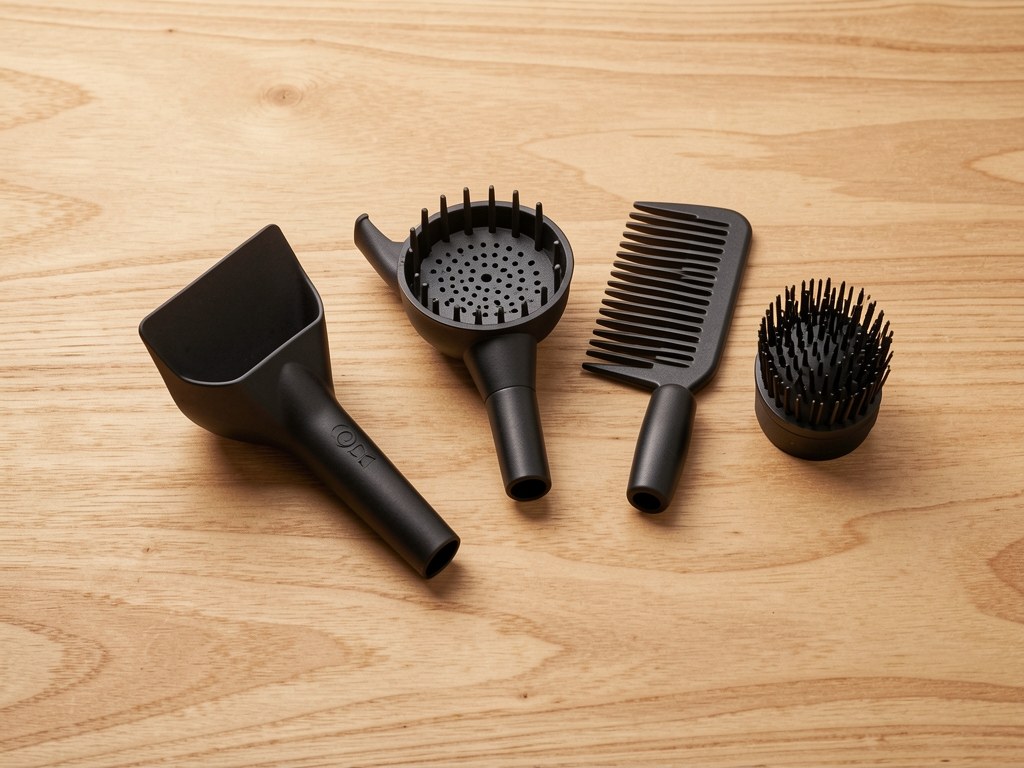
Most hair dryers ship with at least one attachment, and some include a full set. The four common types are the concentrator nozzle, the diffuser, the wide-tooth comb attachment, and the brush attachment. Each changes how air leaves the dryer and therefore changes what the tool is good at.
A concentrator nozzle is a flat, narrow attachment that directs airflow into a focused stream onto a specific section of hair. A diffuser is a bowl-shaped attachment with prongs or vents that disperses airflow over a larger area instead of directing it in a single stream. Comb and brush attachments are designed to detangle, stretch or smooth hair while drying, combining two steps in one tool.
Not every dryer accepts every attachment, and not every attachment suits every hair type. The sections below explain what each one does, who it tends to suit, and how to care for it.
- Concentrator nozzle: focused airflow for precision and smoothing.
- Diffuser: dispersed airflow to support curl pattern and reduce frizz.
- Wide-tooth comb attachment: gentle detangling and even heat distribution for curls and coils.
- Brush attachment: drying, stretching and smoothing for coils, tight textures and shorter lengths.
Sources: Haste Hair, Vega, Dyson, Bio Ionic, PATTERN Beauty
Diffuser: what it does and who it suits
A diffuser is a bowl-shaped attachment with prongs or vents that disperses airflow over a larger area instead of directing it in a single stream. That wider, softer airflow is used to dry curly and wavy hair while maintaining natural curl pattern and reducing frizz. It is suitable for wavy hair (Type 2A–2C), curly hair (Type 3A–3C) and coily hair (Type 4A–4C). The same attachment can also benefit straight hair by adding subtle volume and movement, although it does not create curls.
Technique matters as much as the attachment. Diffusers are recommended for use on low to medium heat and low airflow settings to avoid disrupting curl formation and to reduce frizz. When using a diffuser, hair should be about 80–90% dry before switching to a cool setting to finish and set the style. Excessive heat or airflow during diffusing can disrupt curl formation and cause frizz, so lower settings are recommended.
- Best for: wavy, curly and coily hair; also adds volume to straight hair.
- Airflow: dispersed over a larger area rather than a single stream.
- Settings: low to medium heat and low airflow.
- Finish: switch to cool when hair is about 80–90% dry.
Sources: Dyson, Bio Ionic, PATTERN Beauty, OZ Hair & Beauty
Concentrator nozzle: direction and smoothing
A concentrator nozzle is a flat, narrow attachment that directs airflow into a focused stream onto a specific section of hair. It is recommended for precise styling and for smoothing hair into a polished look. By concentrating heat on a specific hair section, it is described as helping reduce frizz and speeding up the drying process.
Unlike a diffuser, the concentrator does not spread air. That makes it useful when you want to direct airflow along the length of a section rather than around it. It is commonly used for blowouts and for smoothing the surface of the hair.
So is a concentrator nozzle necessary for blowouts? Sources describe it as preferred for precise, sleek styling rather than strictly required. If your goal is a polished, directed finish, it is the attachment most associated with that result. If you only need to remove moisture, a concentrator may not be essential.
- Shape: flat, narrow attachment.
- Airflow: focused, concentrated stream directed at one section.
- Primary goal: precision styling and smoothing for a polished look.
- Reported effects: described as speeding up drying and helping reduce frizz when used correctly.
- Cleaning: detach and wipe with a clean cloth after use.
Sources: Haste Hair, Vega
Comb and brush attachments
Comb and brush attachments are designed to detangle, stretch or smooth hair while drying, combining two steps in one tool. The two types have different jobs.
A wide-tooth comb attachment is intended for gentle detangling of wet or dry curls and coils while providing even heat distribution. Air passes through wide-set prongs, so the attachment is aimed at curly and coily hair rather than at precision smoothing.
A brush attachment is intended for drying, stretching and smoothing coils and tight textures as well as shorter lengths. Air passes through the bristles. The brush head is attached to the dryer outlet, so you dry and shape in the same motion.
Whether comb attachments damage hair is not answered directly by the sources reviewed here. The safest reading of the available guidance is that technique and setting matter: detangling gently and avoiding high heat or aggressive pulling reduces the chance of problems. If your hair is prone to breakage, start on a low setting and work in small sections.
| Attachment | Shape | Airflow pattern | Primary goal | Intended hair types |
|---|---|---|---|---|
| Wide-tooth comb attachment | Comb-like teeth attached to the dryer outlet | Air passes through wide-set prongs | Gentle detangling of wet or dry curls and coils while providing even heat distribution | Curly and coily hair |
| Brush attachment | Brush head attached to the dryer; air flows through the brush | Air passes through bristles | Drying, stretching and smoothing coils and tight textures, as well as shorter lengths | Coils and tight textures, and shorter lengths |
Sources: PATTERN Beauty
Other accessories and gimmicks to evaluate
The sources reviewed here do not name specific gimmick accessories beyond the four common types. That absence is itself useful: it means any extra piece should be evaluated on whether it changes airflow direction, airflow spread, or how the hair is held during drying.
A concrete example of a non-standard accessory is the wide-tooth comb attachment and the brush attachment from PATTERN, which are described as separate attachments that combine detangling or stretching with drying. These are not gimmicks, but they show how an accessory can have a clear mechanical job: the comb detangles, the brush smooths and stretches.
Model-specific accessories also matter. Some diffuser attachments are model-specific rather than universal; for example, the Parlux 385 Diffuser is stated to fit only the Parlux 385 Power Light Ceramic and Ionic Hair Dryer. Within one brand, fit can vary too: FHI Heat's diffuser is compatible with some of its dryers but not the Mini Turbo Dryer. If an accessory is marketed as a gimmick but does not state compatibility or a clear airflow purpose, treat it as unverified.
- Check whether the accessory narrows, widens or holds hair.
- Prefer accessories with a stated compatibility range or model list.
- Be cautious of claims that are not tied to a specific airflow job.
Sources: PATTERN Beauty, FHI Heat, OZ Hair & Beauty
Matching attachments to hair type and goal
The quickest way to choose is to start from the result you want. If you want definition and frizz control for waves, curls or coils, a diffuser is the usual starting point. If you want a smooth, directed finish or a blowout, a concentrator nozzle is the usual starting point. If you want to detangle while drying curls or coils, a wide-tooth comb attachment is the tool described for that job. If you want to stretch and smooth coils or tight textures, a brush attachment is the tool described for that job.
For straight hair, a concentrator is the conventional choice for smoothing, while a diffuser can add subtle volume and movement without creating curls. For wavy, curly and coily hair, a diffuser is suitable across the Type 2A–2C, 3A–3C and 4A–4C bands, and the wide-tooth comb and brush attachments are aimed at detangling, stretching or smoothing.
A single hair dryer may include multiple attachments such as a diffuser, concentrator nozzle, wide-tooth comb and brush attachment, so you can often match the attachment to the goal on the same tool.
| Attachment | Hair type or length | Main goal | Key setting or use note |
|---|---|---|---|
| Concentrator nozzle | All hair types according to one retailer guide, but not independently verified | Precision styling and smoothing for a polished look | Direct airflow at one section; detach and wipe clean after use |
| Diffuser | Wavy (2A–2C), curly (3A–3C), coily (4A–4C); also adds volume to straight hair | Maintain curl pattern, reduce frizz and enhance definition | Low to medium heat and low airflow; finish on cool at about 80–90% dry |
| Wide-tooth comb attachment | Curly and coily hair | Gentle detangling of wet or dry curls and coils while providing even heat distribution | See manufacturer's instructions for your model |
| Brush attachment | Coils and tight textures, and shorter lengths | Drying, stretching and smoothing coils and tight textures | See manufacturer's instructions for your model |
Sources: Haste Hair, Dyson, Bio Ionic, PATTERN Beauty
Cleaning and attachment care
Attachments collect dust, hair residue and product buildup, so cleaning them is part of keeping airflow consistent. Guidance varies by attachment type and by manufacturer.
For a diffuser, cleaning guidance includes wiping with a damp cloth after each use and rinsing under warm water for deep cleaning. For a concentrator nozzle, cleaning guidance includes detaching after use and wiping with a clean cloth to remove dust, hair residue and product buildup.
The sources reviewed here do not give a validated cleaning interval for comb or brush attachments. As a practical routine, follow the manufacturer's instructions for your specific model and inspect the attachment before each use. If airflow seems weaker than usual, clean the attachment before assuming the dryer is at fault.
- Diffuser: wipe with a damp cloth after each use; rinse under warm water for deep cleaning.
- Concentrator nozzle: detach after use and wipe with a clean cloth.
- Comb and brush attachments: follow the manufacturer's guidance for your model.
- Check attachments for buildup if airflow feels reduced.
Fit, compatibility and what to check before buying
Attachment compatibility varies by brand and model. Some diffusers are model-specific: the Parlux 385 Diffuser is stated to fit only the Parlux 385 Power Light Ceramic and Ionic Hair Dryer. Even within a brand, fit can vary: FHI Heat's diffuser is compatible with some of its dryers but not the Mini Turbo Dryer.
Universal-fit attachments are marketed as fitting a range of dryers. One retail listing describes a universal diffuser for nozzle sizes from 1.4 to 3.1 inches. That is a claimed fit range for one product, not a cross-brand standard. A universal attachment that fits loosely may not stay in place, and a forced fit can damage the attachment or the dryer outlet.
Before buying, check the stated nozzle diameter or model compatibility list. If you already own a dryer, measure the outlet with a ruler or check the manual. No on-page calculator is provided; this is a simple physical check. The Dyson diffuser and its magnetic connector system are specific to Dyson's own ecosystem and are not a general rule for other brands.
- Model-specific attachments are made for a named dryer or model family.
- Universal-fit attachments state a size range but do not guarantee a fit on every dryer.
- A loose attachment may fall off; a forced fit may cause damage.
- Use a ruler to measure the nozzle outlet or check the manual before buying.
Sources: Amazon product listing, FHI Heat, OZ Hair & Beauty
Frequently asked questions
Can I use a diffuser on straight hair?
Yes. A diffuser is described as benefiting straight hair by adding subtle volume and movement, although it does not create curls. Use low to medium heat and low airflow, and finish on a cool setting when the hair is about 80–90% dry.
Sources: Dyson, Bio IonicIs a concentrator nozzle necessary for blowouts?
Sources describe the concentrator nozzle as recommended for precise styling and for smoothing hair into a polished look, but they do not state that it is strictly necessary for a blowout. It is the attachment associated with a directed, sleek finish rather than a requirement for removing moisture.
Sources: Haste Hair, VegaDo comb attachments damage hair?
The sources reviewed here do not directly answer whether comb attachments damage hair. The wide-tooth comb attachment is described as intended for gentle detangling of wet or dry curls and coils while providing even heat distribution. Whether damage occurs depends on technique and settings, so use gentle passes and avoid high heat.
Sources: PATTERN BeautyAre universal attachments reliable?
Universal-fit attachments are marketed with a stated nozzle size compatibility range, such as 1.4 to 3.1 inches in one product listing. That is a claimed fit range for a specific product, not a cross-brand standard. Model-specific attachments exist and within-brand fit can vary, so check the stated size or model compatibility before buying.
Sources: PATTERN Beauty, Amazon product listing, FHI Heat, OZ Hair & BeautySources
- Hair Dryer Attachments Explained: What Does Each Tool Do? — Haste Hair
- What are Hair Dryer Attachments: Guide on How to Use Them — Vega
- How to use a diffuser hair dryer? — Dyson
- What Does a Hair Diffuser Do? Guide to Frizz-Free Curls | Bio Ionic — Bio Ionic
- Blow Dryer for Curly Hair: Diffuser & Other Attachments | PATTERN — PATTERN Beauty
- Universal Hair Diffuser Attachment for 1.4"-3.1" Blow Dryer Nozzles — Amazon product listing
- Diffuser Attachment for Hair Dryers – FHI Heat™ — FHI Heat
- Parlux 385 Hair Dryer Diffuser | OZ Hair & Beauty — OZ Hair & Beauty