Why thick hair takes longer to dry and where moisture hides
Dense hair is not just a lot of hair. The strands are packed closely together, so the gaps that let warm air move between strands are smaller. Airflow slows down as it pushes into the mass, and the evaporated moisture has a harder time escaping. The surface can feel dry while the inner layers are still wet, which is why a quick overall pass often ends with damp patches near the scalp or under the top layer.
That uneven drying is what leads to repeated heat exposure. When you find a cold, damp section after you thought you were finished, you go back over it with the dryer, often at the same heat you used at the start. The outer hair gets dry, hot and static-prone while the inner layers slowly give up their water.
- Thick or densely packed hair holds moisture longer than finer hair and takes longer to dry.
- Airflow has difficulty reaching the inner layers, so the outer sections can feel dry while deeper layers remain damp.
- Even after the surface looks dry, thick hair may still be wet underneath, which leads to repeated heat exposure when users go back over missed sections.
Sources: Programming Insider, HomeWiseReview, Boltflow (boltflow.co.uk)
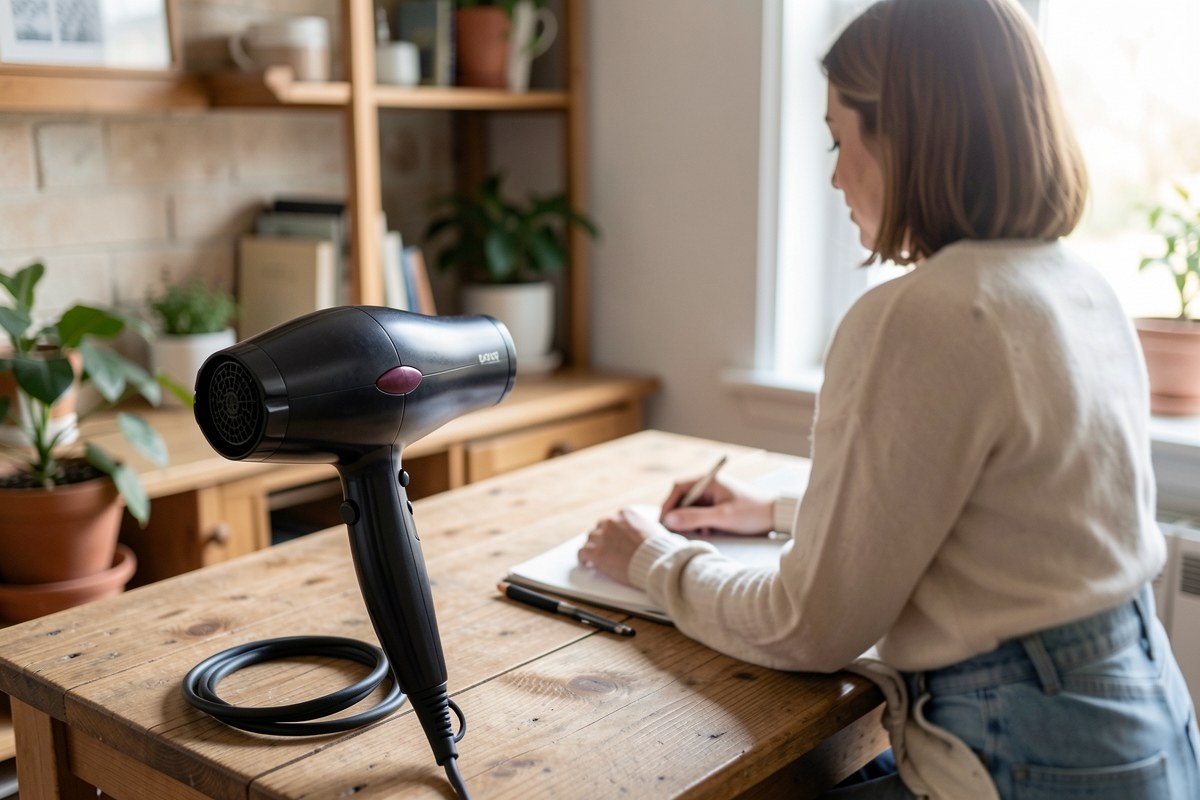
Airflow and wattage considerations for thick hair
For thick hair, airflow does more of the drying work than raw heat. Airflow is what carries evaporated moisture away from the hair; heat only speeds up evaporation. A dryer that moves a strong, steady stream of air through dense sections will dry them faster and more evenly than a hotter dryer with weak airflow.
Wattage is a rough indicator of how much power a dryer can draw, not a direct measure of how well it dries. Two dryers of similar wattage can perform differently depending on motor efficiency, nozzle design, and how concentrated the airflow stays. That said, most guidance for thick hair starts at the higher end of the consumer range.
Published guidance is not perfectly consistent. One professional education source states that most hair types can be blow dried effectively at around 1,800 watts, while very thick hair may need 2,000 watts or more. A brand buying guide describes 1,800W to 2,000W as adequate for most hair types and 2000W+ for thick hair. A non-US SEO roundup recommends a wider 1,800W to 2,400W range for thick, long hair. The lower bound of 1,800W is the common ground; the 2,400W upper bound comes from a single source and should not be treated as a requirement.
- Airflow matters more than raw heat for drying thick hair, because airflow carries evaporated moisture away.
- For thick hair, a high-speed airflow setting combined with medium heat is generally described as the balance point.
- Wattage alone does not determine drying performance; motor efficiency, nozzle design, and airflow concentration matter.
- A common starting range is about 1,800W to 2,000W, with 2000W+ sometimes described for very thick hair.
- A single non-US source suggests 1,800W to 2,400W for thick, long hair; treat the upper bound as an outlier rather than a target.
- Ionic dryers are marketed as reducing drying time and frizz by emitting negative ions, but this is a vendor framing rather than independently verified physics.
Sources: Programming Insider, HomeWiseReview, Aeno, Boltflow (boltflow.co.uk), Sam Villa (professional education / salon brand)
Sectioning and layering technique to dry evenly
The single most effective change for thick hair is to stop drying it as one mass. Professional technique is to rough-dry roots and mid-lengths until the hair is mostly dry, keeping the dryer moving and aiming airflow down the hair shaft, before any finishing work is attempted. Aiming down the shaft helps the cuticle lie flat rather than lifting it with back-and-forth air.
Stylists split thick hair into at least four sections, and go smaller for very dense hair, so the top layer is not re-dried while the under layers stay wet. Clips hold the unworked sections out of the way. You dry the lower layers first, then release the next layer, and so on. This is slower per pass but avoids the cycle of repeatedly blasting the surface while the interior stays damp.
- Towel-blot or air dry soaking-wet hair to about 50–60% dry before using the dryer.
- Apply a heat protectant before blow drying.
- Divide the hair into at least four sections, using smaller sections for very dense hair.
- Clip up the upper layers and start with the lowest layer, working upward.
- Rough-dry roots and mid-lengths with high airflow and medium heat, keeping the dryer moving.
- Continue until the hair is roughly 80% dry before starting brush work or finishing.
- Reduce heat in the final minutes and rely on airflow and tension for smoothness.
- Finish with a cool shot to help close the cuticle and set the style.
Sources: HomeWiseReview, Aeno, Boltflow (boltflow.co.uk), Sam Villa (professional education / salon brand)
Using higher heat safely with regular cool-downs
Higher heat speeds evaporation, but on thick hair the risk is not only surface temperature. Heat that keeps building in the same spot while you wait for the inner layers to dry can leave the outside feeling brittle. The practical safeguard is to reduce heat as soon as the hair is no longer soaking wet, and to keep the dryer moving rather than parking it on one section.
Dropping the heat setting in the final minutes and relying on airflow and tension is described as producing smoother, less breakage-prone ends on thick hair. A cool-shot or cool-air finish at the end of drying is used to help close the cuticle and set the style. Three separate sources describe this cool finish, though it is practitioner guidance rather than measured data.
One caution worth checking against your own dryer: a clogged or dirty filter degrades performance. When airflow drops, it is tempting to compensate with higher heat for longer. Cleaning the filter restores airflow and reduces the need to overheat.
- Use high speed with medium heat while the hair is still wet.
- Reduce heat once the hair is no longer soaking wet.
- Keep the dryer moving; do not hold it on one damp patch.
- Check and clean the dryer filter so you are not compensating for weak airflow with more heat.
Sources: HomeWiseReview, Aeno, Boltflow (boltflow.co.uk), Sam Villa (professional education / salon brand)
When to move from rough-dry to finishing
Rough drying is for removing the bulk of the water. Finishing is for shaping and smoothing. The transition point matters because finishing work done too early means the hair is still losing water, and any style you build will collapse or frizz as it dries further.
The benchmark described by professional education guidance is roughly 80% dry before brush work or finishing begins. At that point, switch to a lower heat setting and use tension — a brush or your hand pulling the section gently — so the air does the smoothing rather than the temperature.
If you are using a concentrator, this is the stage for it. Concentrator nozzles direct and concentrate airflow for smoothing straight or wavy hair, while diffusers are used for curly or wavy hair to support natural texture. A large round brush with natural boar bristles is recommended for blow drying thick hair by one professional education source. The concentrator plus tension plus reduced heat is what turns a rough-dried thick head into a smooth finish.
- Rough-dry until roughly 80% dry, then move to finishing.
- Switch to lower heat and use tension for smoothing.
- Use a concentrator for straight or wavy finishes; use a diffuser for curls.
- A large round brush with natural boar bristles is a recommended tool for thick hair.
Sources: HomeWiseReview, Aeno, Boltflow (boltflow.co.uk), Sam Villa (professional education / salon brand)
How attachments change the job on thick hair
Attachments do not just change the shape of the airflow; they change how much of the hair the air can reach. On thick hair, a narrow concentrator keeps the stream tight so it can push between dense sections, while a diffuser spreads the air and reduces direct force on the scalp.
The consistent guidance is that concentrator nozzles direct and concentrate airflow for smoothing straight or wavy hair, while diffusers are used for curly or wavy hair to support natural texture. If your thick hair is straight or wavy, the concentrator is usually the attachment that helps you finish; if it is curly, the diffuser is the one that prevents the airflow from disrupting the pattern you want to keep.
- Concentrator: directs and concentrates airflow for smoothing straight or wavy hair.
- Diffuser: spreads airflow for curly or wavy hair to support natural texture.
- Match the attachment to the finish you want, not to the dryer's marketing label.
Sources: Programming Insider, HomeWiseReview, Aeno, Sam Villa (professional education / salon brand)
What to check before buying a dryer for thick hair
The specifications that matter most for thick hair are airflow strength, heat range, and whether the nozzle concentrates the stream. Wattage is a starting filter, not the deciding number. A dryer rated at 1,600W with strong, focused airflow may dry dense hair better than a 2,000W dryer with a wide, soft output.
The table below summarises specifications as stated by a single affiliate review publisher for five dryers it discusses for thick-hair use. These figures are reported by that source and should be verified against manufacturer listings before you rely on them. They are included to show the range of configurations, not to rank the dryers.
| Model | Stated wattage | Stated heat settings | Stated speed settings | Stated cool shot | Source-stated strength for thick hair |
|---|---|---|---|---|---|
| Dyson Supersonic Hair Dryer | 1600W | 4 (includes cool) | 3 | Not stated | Focused airflow that reaches dense sections; described as fast and consistent for rough-drying then smoothing |
| Elchim 3900 Healthy Ionic Hair Dryer | 2000W | 3 | 2 | Not stated | Strong steady airflow described as excelling at rough-drying roots, where density slows drying |
| ghd Helios Professional Hair Dryer | 1875W | 3 | 2 | Yes | Concentrated airflow described as helping lay down the cuticle for a smoother, less fluffy finish |
| BaBylissPRO Nano Titanium 2000-Watt Dryer | 2000W | 6 total (heat/speed combined) | 6 total (heat/speed combined) | Yes | Powerful airflow described as useful for quick rough-drying; can run hot, so heat should be reduced past the soaking-wet stage |
| Shark HyperAIR Hair Dryer | 1600W | 3 | 3 | Yes | Strong airflow described as best used to rough-dry in sections, then refine with a focused attachment |
Sources: HomeWiseReview
Frequently asked questions
Do I need a higher wattage dryer for thick hair?
Not automatically. Higher wattage gives a dryer more power to draw, but drying performance also depends on motor efficiency, nozzle design, and how concentrated the airflow stays. Published guidance commonly points to the 1,800W–2,000W range as a sensible starting point for thick hair, with 2000W+ sometimes suggested for very thick hair. One non-US source suggests up to 2,400W, but that upper bound is an outlier and not a requirement. Airflow strength and a concentrator nozzle often matter more than the number on the label.
Sources: HomeWiseReview, Aeno, Boltflow (boltflow.co.uk), Sam Villa (professional education / salon brand)How long should thick hair take to dry?
There is no reliable norm to quote. The only time figure in the available guidance is a single brand blog's statement that a low-powered dryer may take 30 minutes or longer on thick or long hair, and that source gives no test method. Drying time also depends on how wet the hair is when you start, how many sections you use, your dryer's airflow, and the room. Rather than aiming for a time, aim for the technique: blot to about 50–60% dry, rough-dry in sections at high airflow and medium heat, and expect the finishing stage to add more time after the hair is roughly 80% dry.
Sources: Aeno, Boltflow (boltflow.co.uk), Sam Villa (professional education / salon brand)Is it okay to leave thick hair slightly damp?
The guidance reviewed for this page does not address whether leaving thick hair slightly damp is acceptable. What it does describe is the practical consequence of incomplete drying: if the surface looks dry but deeper layers are still wet, people tend to go back over the missed sections with the same heat they used at the start, which means the outer hair gets a second round of heat. If you stop before the hair is fully dry, be aware of that pattern and avoid simply re-blasting the surface. For anything related to scalp health or hair loss, ask a qualified professional rather than relying on a general guide.
Sources: Programming Insider, HomeWiseReviewShould I use a concentrator on thick hair?
Yes, if your goal is a smooth, straight or wavy finish. Concentrator nozzles direct and concentrate airflow for smoothing straight or wavy hair, which is exactly what dense sections need — a tight stream that can push between layers rather than a wide, soft output that sits on the surface. Use the concentrator from the rough-dry stage onward if you are working sections, and switch to a diffuser if you are keeping a curly or wavy pattern and want to support the natural texture instead of smoothing it.
Sources: Programming Insider, HomeWiseReview, Aeno, Sam Villa (professional education / salon brand)Why does my thick hair feel dry on top but damp underneath?
Airflow has difficulty reaching the inner layers of densely packed hair, so the outer sections can feel dry while deeper layers remain damp. This is the main reason drying thick hair in a single pass does not work well: the top layer absorbs the heat and looks finished while water is still sitting closer to the scalp. Sectioning from the bottom up, and re-checking the under-layers by hand, is the standard fix.
Sources: Programming Insider, HomeWiseReviewShould I dry my hair completely before styling it?
The technique guidance reviewed here is to rough-dry until the hair is roughly 80% dry, then move to brush work and finishing. That is a practitioner benchmark, not a measurement, but it reflects the logic of the process: finishing work done on soaking-wet hair has to be repeated once the hair dries further. Bring the hair to about 80% dry with high airflow and medium heat, then drop to lower heat and use tension and a brush to finish.
Sources: Sam Villa (professional education / salon brand), HomeWiseReviewDoes a higher heat setting dry thick hair faster?
Not necessarily, and it carries a cost. Airflow is what carries evaporated moisture away from the hair, so a strong, steady stream of air at medium heat is generally described as the balance point for thick hair. High heat with weak airflow can dry the surface while leaving the interior damp, which leads to repeated passes over the same sections. Reduce the heat once the hair is no longer soaking wet, keep the dryer moving, and check the filter so you are not compensating for weak airflow with more temperature.
Sources: Programming Insider, HomeWiseReview, Boltflow (boltflow.co.uk)Are ionic dryers worth it for thick hair?
Ionic dryers are widely marketed as reducing drying time and frizz by emitting negative ions that counteract positively charged water molecules. That mechanism comes from vendor and brand-adjacent content rather than independent testing, so treat it as a marketing claim rather than established physics. Ionic features are common on dryers that also have strong airflow and good heat control, which are the characteristics that matter most for thick hair. If a dryer's airflow and nozzle work for your hair, the ionic label is a secondary consideration.
Sources: Aeno, Sam Villa (professional education / salon brand)Sources
- Choosing the Right Hair Dryer for Thick Hair - Programming Insider — Programming Insider
- Best Professional Hair Dryers for Thick Hair and Faster Drying — HomeWiseReview
- Best Professional Hair Dryers for Thick Hair and Faster Drying — HomeWiseReview
- Hair Dryer Types: The Difference Between Hair Dryers — Aeno
- Best Hair Dryers for Thick, Long Hair: Our Top Choices — Boltflow (boltflow.co.uk)
- The Ultimate Guide To Blow Dry Hair Without Damage — Sam Villa (professional education / salon brand)